


Websites And The Human Psyche

source: activistpost.com
Claudia Okyere-Fosu explores how websites affect the human psyche.
By employing certain techniques, designers can ensure users encounter websites they’ll enjoy and hopefully keep coming back to.
Emotion and Design
Emotional design has become a powerful tool in creating exceptional user experiences for websites. However, it wasn’t always that way, ‘emotions’ were drowned out by rational functionality and efficiency. Sadly, we’re so busy trying to adapt to the web as a medium that we’ve lost sight of its true potential. The potential to solve problems, give users what they want.
If it wasn’t for the work of Don Norman and Aarron Walter, we might still be focusing on improving processes, neglecting the guiding hand of emotional design.
Their approach - attractive things work better, true I guess. How about this? Attractive products make problem-solving easier. Or attractive products make people feel positive so they’re more likely to come up with a solution. Let’s be honest, mentally speaking you can face solving problems when you’re in a good place.
Aarron Walter describes how important emotional experiences are as they make a profound imprint on our long-term memory and create: "an experience for users that makes them feel like there’s a person, not a machine, at the other end of the connection."
If you want people to interact with your design, they need to connect to the human aspects of it. You need to coax them to follow a process by allowing them to believe it’s the natural way to go.
So how can web designers start to apply this knowledge?
Implement emotion in your visual design. A website can include several elements that can make a design more personal, these are regarded as emotional carriers. So for instance the use of colours, images, shapes, humour and tone of voice.
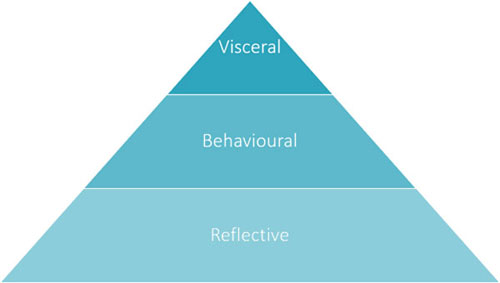
In his talk ‘three ways good design makes you happy’, Don Norman conducted the necessary research and came up with three levels of visual design that need to be considered in order for a design to be both usable and pretty.
source: Don Norman
He identified these levels: Visceral, Behavioural and Reflective as the way that designers can build emotion into their products. The first Visceral also has the lowest influencing power level and deals with first impressions, preconsciousness. The second Behavioural is concerned with function and addresses the users’ needs through ease of use. The final and most potent level, Reflective focuses on reasoning and defines a users’ overall impression of a product.
You could say that the user is on a mental journey from ‘meeting’ the visual design to experiencing how the product works to eventually considering the long-term impact of the design.
These three cognitive levels are based on the way our brains function and can be seen as a guide to creating a more appealing, effective, pleasurable and memorable design.
In any good design all three levels should work together. It’s worth noting here that they can come into conflict with each other. For instance, our opinion of a design after having thought about it might diverge from our ‘horrible’ initial impression of it. Also people might have different preferences for the three levels.
Combining these levels in the right way can make a design:
- Appealing – grab the user’s attention and influence their perception.
- Effective – guide the user’s attention and make sure they find what they are looking for.
- Pleasurable – allow the user to appreciate your website and have fun.
- Memorable – build a relationship with the user and ensure a positive memory of you.
Human-Computer Interaction
Human-Computer Interaction (HCI) researches the design and use of computer technology, focusing on the interfaces between people (users) and computers. Researchers in HCI are interested in developing methodologies, experimenting with new devices, prototyping new software systems, exploring new paradigms and developing models and theories of interaction.
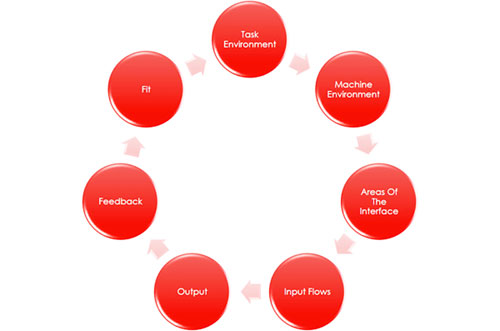
The flow between the human and the computer is defined as the loop of interaction. The loop has several aspects to it including:
source: Wikipedia
Before I delve into design methodologies and techniques, I just want to briefly mention heuristics.
The objective of heuristics is to produce a solution in a reasonable time frame that is sufficient for solving the problem at hand. I’ll talk more about this later. Many virus scanners use heuristic rules for detecting viruses and other forms of malware. Heuristics can also be employed during statistical analysis.
Everything we use such as software, apps, equipment, processes and services has a user experience (UX) component. The user experience of a product or service is what the user feels, thinks and experiences in the course of interacting with this product or service.

source: Ben Melbourne
The UX universe encompasses two disciplines: User Interface (UI) design and Information Architecture (IA). UI is concerned with the mechanics of how the user would interact with the product or service. It takes into account accessibility, usability and new disciplines like gamification (i.e. earning points and enjoying rewards).
Gamification is the use of game theory and game mechanics in a non-game context to engage users in solving problems and increase users’ contributions.
This leads me to Incentive-Centred Design (ICD), the science of designing a system according to individual and user incentives. The incentive being that users have a platform to broadcast their own content, engaging with other users as they do so. Websites such as You Tube and Wikipedia are fashioned with this in mind and highlight user-generated content.
The role ICD plays can help systems benefit their users and ultimately achieve better results. I can only assume this will lead to higher user satisfaction rates.
IA is concerned with how information is structured and organised. It is about what information is on offer. IA affects the ability of users to comprehend the content in a service or website as well as create cognitive way finding maps through the content.
Luckily for us web designers; there is an emerging community of practice focussed on bringing principles of design and architecture to the digital landscape. That can only be a good thing.
Whilst conducting research for this article, I stumbled across an amusing blog from UX Beginner, discussing the seven reasons to date a UX Designer.

source: eatthedamncake.com
Joking aside, the advice is pretty sound:
- Don’t assume - you are not the user.
- Test things out - and find solutions, solutions, solutions!
- Jack of all trades - make sure you have a flexible, wide skill set.
- Understanding that things are interrelated - remember everyone brings value.
- Empathy - great designers care.
- Team orientated - working with others is essential to success.
- Humility - divorce your ego from your design.
Theses character qualities are essential especially when you consider the UX Designer has to collaborate with: business executives to craft strategy, programmers to realise design in code. Above all, UX Designers work with customers to understand their needs.
The UX Designer has to learn to compromise and be open to seeing things differently, reading users’ actions and behaviours closely as they could be the solution to a design problem. After all:
"a truly good designer will never feel they have achieved the perfect design."
This blog may well have been named seven soft skills that make a good UX Designer. I like to refer to them the Seven UX Principles.
"Get out of my way and get me to my goal!"
So this is all very well and good but people still aren’t able to access what they need from websites. In fact some pretty funny scenarios can occur. A German man threw his PC out of the window because he couldn’t find what he was looking for! One person described his computer as "my expensive punch bag."

source: techeye.net
People need good websites. Websites are no longer just an add-on to a company’s growing portfolio. They are now becoming the main means of communication, the go to resource.
Jakob Nielsen PhD is a Danish world renowned usability expert. He currently holds 79 United States patents on ways of making the internet easier to use.
He stated that the architectural term ‘form follows function’ should be applied to screen based interfaces. Jakob mused that people are constantly saying: "get out of my way and get me to my goal!"
Jakob suggests that websites should have very little on them; people don’t want ‘loud’ websites. For example audio files should play when it’s appropriate and not as soon as a person lands on a webpage. This frustrates the user as they are often accessing the site during their working hours. Also the continued rise of open plan offices as the norm instantly causes the user to fall foul of colleagues.
Text on websites can be underestimated at times. Text Jakob says has a great advantage as it’s easy to scan down the text, especially if it’s written for the web.
Remember I mentioned heuristics before? Well Jakob believes people don’t enjoy paying utility bills so the fastest way to pay as possible should be considered when designing such a website. Information needs to be upfront. Unfortunately, designers tend to focus on what they think about the design and not on how others will see it.
When it comes to big media users want to access the material quickly, they want to understand it and they don’t want extraneous material to interfere. ‘Fashion should never trump usability’ says user interface guru, Bruce Tognazzini. In fact according to Bruce, effective interfaces are visually apparent, instilling a sense of control in their users. These interfaces enable users to make their own decisions and use status mechanisms (like a progress bar) to keep their users aware and informed.
"Where do you draw the line between creativity, spontaneity and polished professionalism?"
Larry Magid asked Jakob this question during his Larry’s World interview. The usability expert’s answer was surprising:
"People don’t care about you; they care about your material so your material needs to be approachable."
So here are five good web design tips from the usability expert:
- Know what people are interested in.
- What is your content about? The headline should tell you.
- Strike a balance between text and pictures.
- Keep it short and in depth. Jakob admits this is difficult to do so provide hyperlinks should your users wish to read further.
- Build a website one page at a time.
Now you know how important it is to include emotion in your web design. So what about the intangibility of websites? Well folks, that’s a topic for another day.
References & Further Reading:
Larry Magid interviews Jakob Nielsen
Building Emotion Into Your Websites
7 Reasons To Date A UX Designer